Case study
Studio Finance Hub
Full Stack Developer (freelance) · Spring Games · 2026 – in development
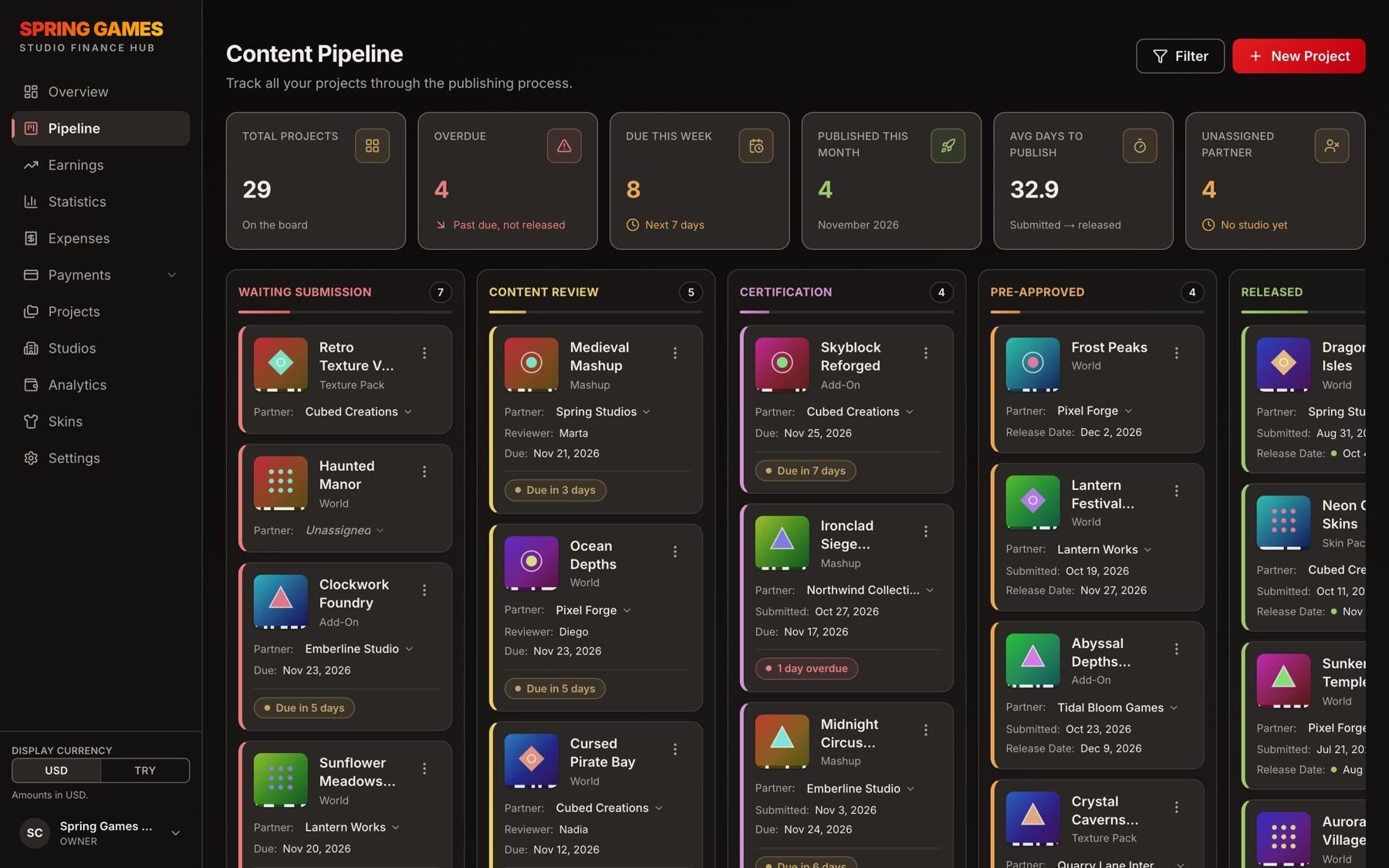
Internal panel Spring Games uses to track its production and finances. I built the second version: I rebuilt the backend from Express to NestJS and Fastify and kept the workflows the studio already used.
Internal project
Context
Spring Games publishes content on the Minecraft Marketplace. It uses an internal panel to track the stage of each product and to run its finances: earnings per partner, invoices, payments, and expenses.
The first version of the panel ran on an Express backend. The studio hired me again to build the second one.
My contribution
I build the whole project: the API, the web panel, and the container deployment.
Technical decisions
- I rebuilt the backend from Express to NestJS on Fastify and kept the Next.js interface and the workflows the studio already used, so the change did not force them to relearn the panel.
- I set the repository up as a monorepo: the API, the web panel, and an in-house 3D skin rendering package.
- The API is organized by business domain, with four fixed layers: controller, service, repository, and entity. Data lives in PostgreSQL through Prisma.
- I removed Redis from the project: it came from the initial template and no module used it, yet the API waited for it to be ready before starting.
Testing
- Automated tests for the API and the panel.
- Architecture tests that fail the build when the code breaks one of the repository's conventions.
- GitHub Actions runs lint, tests, and build on every change, and builds the Docker images for the API and the panel.
Delivery status
- Delivered: the backend rebuilt on NestJS and Fastify, with the interface and workflows from the first version.
- In progress: the release tracking board, per-partner earnings with configurable deductions, and views filtered by team.
Stack
Next.js · NestJS · Fastify · Prisma · PostgreSQL · Docker · GitHub Actions